



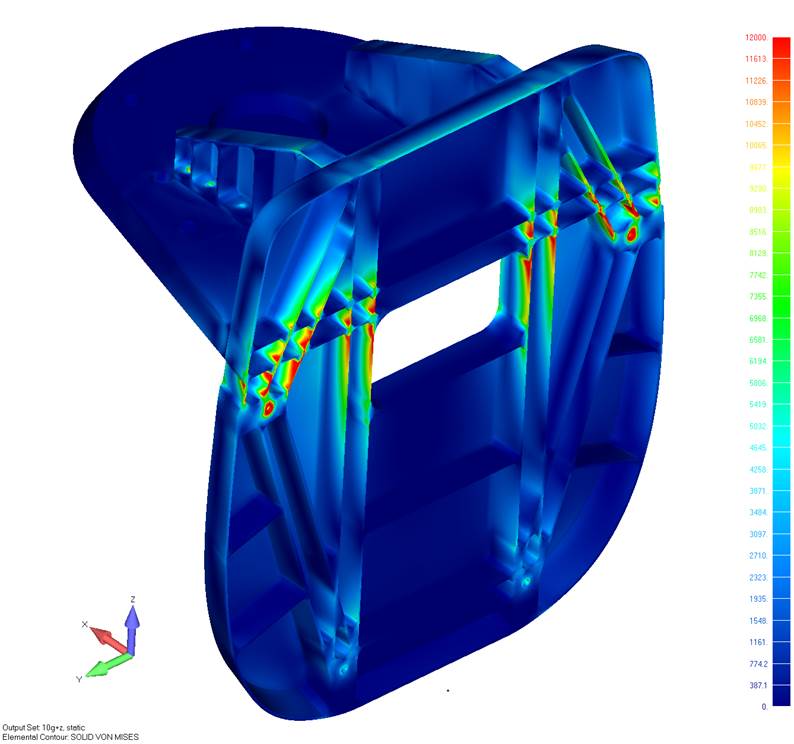
Mace Aviation performs aerospace structural analysis from simple hand calculations through full-aircraft finite element analysis. We use Hypermesh, FEMAP, and NASTRAN, the same industry-standard tools specified in defense and advanced development program contracts. Our analysis team is integrated with our design and fabrication operations. Analysis results directly inform the parts we build.
Mace Aviation uses Hypermesh, FEMAP, and NASTRAN. These are the tools specified in defense and advanced development contracts. Programs managed by NAVAIR, the Army, or major prime contractors often require that analysis be performed in specific software packages. Mace Aviation meets those requirements.
Our design software, CATIA V5 and SolidWorks, is directly integrated with our FEA workflow. Geometry changes are reflected in the analysis model immediately. That enables rapid iteration between design and structural sizing.
The FEA service market is dominated by pure engineering consultancies. These firms typically have little to no hands-on fabrication experience. Mace Aviation is a fabricator that also performs analysis. When we size a composite laminate, we know what it costs to build. When we recommend a design change to reduce stress concentration, we know whether it is manufacturable. This integration between analysis and fabrication is not common in the industry. It is directly valuable to programs that need to control both structural performance and production cost.
A stress report is only useful if it holds up under review. Here’s how a typical analysis moves from CAD to something a customer can put in front of their certification authority or prime contractor.
We start with the geometry and build a mesh sized to the load path, not just the part shape, coarse enough to run efficiently, fine enough that stress gradients in fastener holes, fillets, and joints don’t get averaged away. Boundary conditions and load cases come from the customer’s requirements or, where those aren’t fully defined yet, from our own read of the mission profile and applicable FAR/MIL criteria.
From there we solve for the governing cases, static limit and ultimate, fatigue, and dynamic (modal, frequency response, random vibration) where the application calls for it, and reduce the results to margins of safety at each critical location, not just a color plot. Composite structures get ply-by-ply strength and interlaminar shear checks; metallic structures get checked against the applicable FAR/MIL allowables.
The output, assumptions, load cases, results, and margins at each critical location, is documented so it can go directly into a certification package or a customer’s own engineering review, not just live on our shelf.
Because analysis and fabrication sit under one roof here, that same report also drives what we hand off to the shop, so the parts we build match the assumptions the analysis was run against.
Provide your material, your timeline, and your application. We'll give you a straight answer.
Our analysis work has included FEA of targeting pod structures, wing spar sizing, helicopter nose mount stress plots, and weapons system structural qualification. The M134 pod, MX-25D targeting system, AH-1 nose mount, and Extended Range Weapons Wing have all been through Mace Aviation structural analysis.
Structural analysis work at Mace Aviation is performed on components we also fabricate. Aerospace Composite Fabrication and Aerospace Metallic Structures are produced in-house, meaning FEA results directly inform material selection, layup schedules, and structural geometry before a part is ever built. For programs that start at the design stage, our Aerospace Design and Engineering team works from concept through analysis in the same building.
We use Hypermesh, FEMAP, and NASTRAN. These are the industry-standard tools specified in most defense and advanced development program contracts. Our analysis workflow is directly integrated with CATIA V5 and SolidWorks, enabling rapid iteration between design changes and structural sizing.
Both. Mace Aviation is a fabricator with integrated analysis capability, not a pure consultancy. We routinely perform structural analysis on components we also fabricate, so analysis results directly inform material selection, layup schedules, and tooling design.
Yes. Our analysis work has supported structural qualification for targeting systems, weapons structures, helicopter nose mounts, and weapon wing assemblies. We are familiar with the documentation requirements and load conditions typical of DoD structural qualification programs.
We build the mesh and define load cases and boundary conditions against the customer’s requirements or applicable FAR/MIL criteria, run the governing static, fatigue, and dynamic cases, and reduce the results to margins of safety at each critical location. That documentation, assumptions, load cases, results, and margins, is built to support a customer’s certification package or engineering review, not just sit as an internal file.
Yes. Modal, frequency response, and random vibration analysis are part of our standard FEA capability, run in Hypermesh/FEMAP/NASTRAN alongside static and fatigue work.
Structural analysis is led by Ryan Mace, President and Chief Engineer, a B.S. Aerospace Engineering graduate of Embry-Riddle Aeronautical University with 20+ years across aerospace programs. His background includes design engineering roles at Scaled Composites (Stratolaunch ROC, SpaceShipTwo, WhiteKnightTwo), Lockheed Martin Skunk Works (conceptual design on the X-55A demonstrator), Orbital Sciences Corporation/Northrop Grumman (launch vehicle structures), and NAVAIR (fleet monitoring, F-35 program), before founding Mace Aviation in 2011. That’s the experience running FEA of composite and metallic structures in Hypermesh, FEMAP, and NASTRAN.
Yes, mesh density at fastener holes, fillets, and joints is sized specifically to capture local stress concentrations rather than average them out across the part, which matters for fatigue and damage tolerance work in particular.
Starts with an idea...ends with a product, the sky's the limit.
Cutting edge rapid prototyping, design, engineering and production. Mace Aviation has been our go to for the last 19 years.
Director | L3Harris
Mace Aviation is a unique company that can rapidly design and develop advanced composites for the aerospace industry and then produce these products at a very competitive price. The Mace team is both innovative and practical with decades of experience in the fixed and rotary wing market. They are smart, practical and affordable and very good to work with. Mace is a top notch team.
CEO | MD Helicopters, LLC